From the National Library to Academia Sinica: How the EU Is Rethinking Economic Security
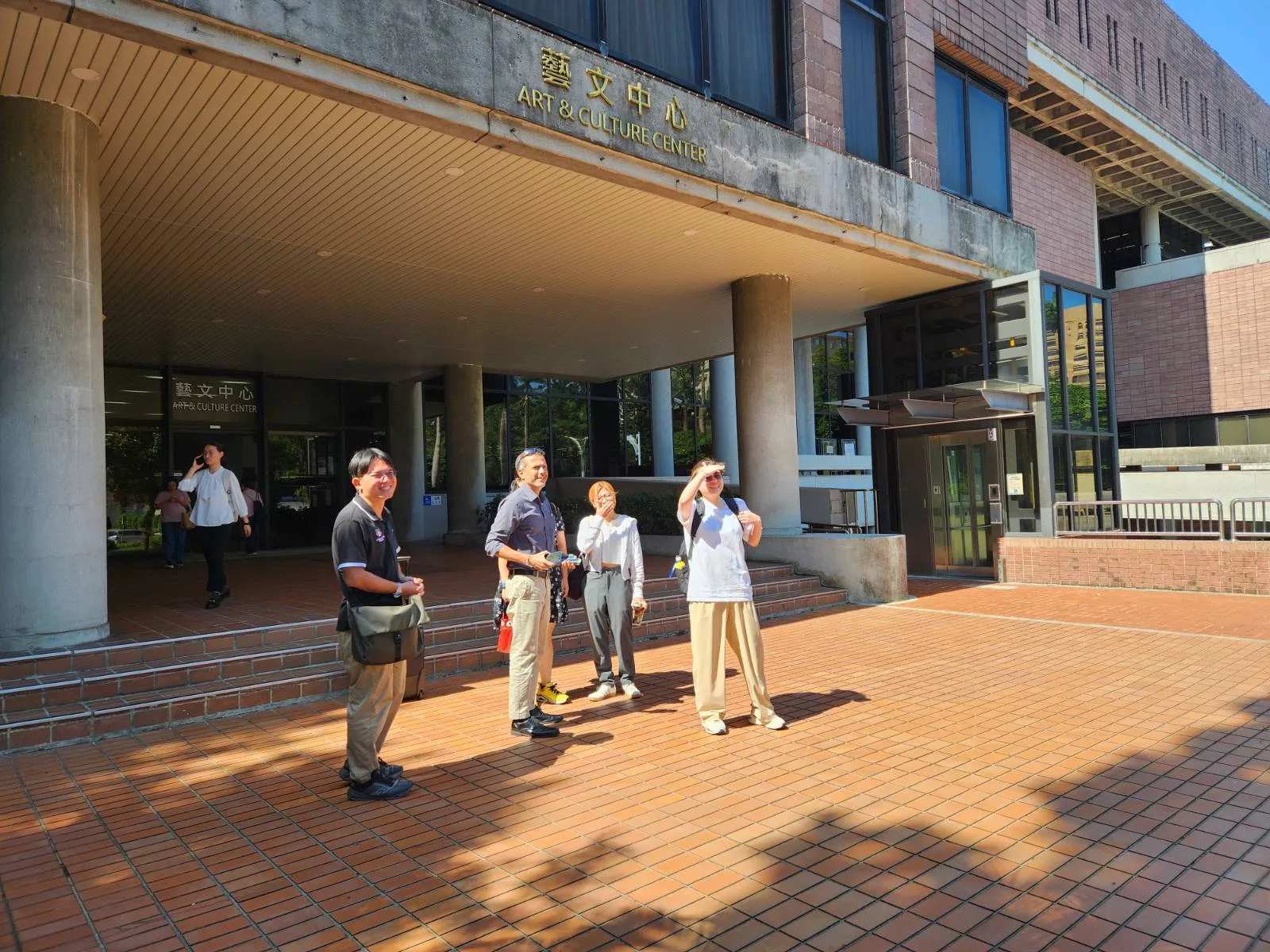
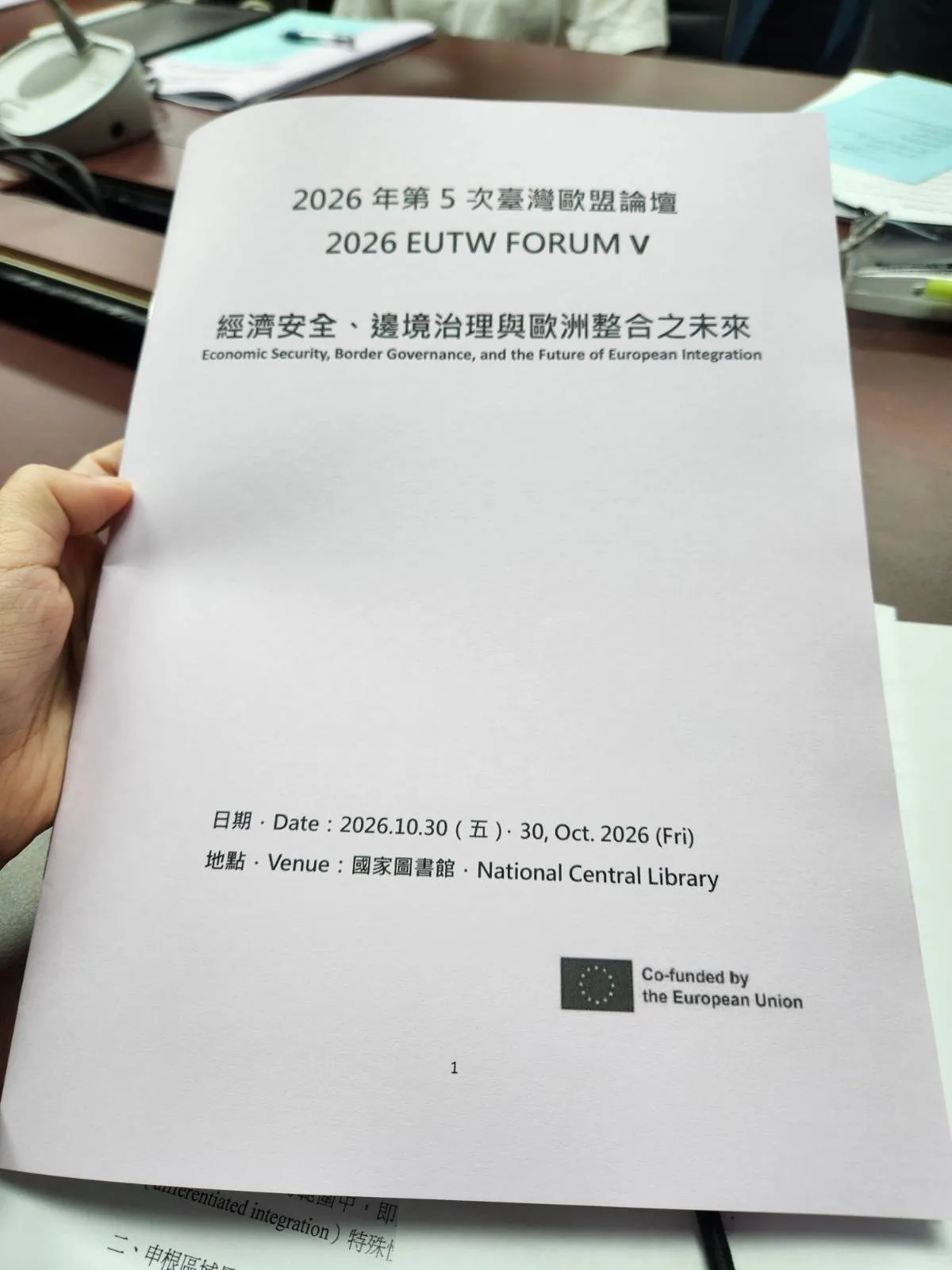
On Friday, October 30, I joined my fellow first-year master’s students at the Graduate Institute of European Studies (GIES) for the 5th Taiwan–EU (EUTW) Forum in Taipei. The trip was led by Prof. Vincent Rollet as part of our EU Integration course. This year’s theme was Economic Security, Border Governance, and the Future of European Integration. The forum was held at the National Library’s Arts Center and organized by the EU Centre in Taiwan, the NTU Centre of Excellence, the NCCU EU Centre and the National Central Library. Prof. Chang Tai-lin chaired the morning, and five scholars presented. Two of those talks stayed with me, so I’ll focus on them here.
Morning: The EUTW Forum
Prof. Cho Chung-hung: the EU’s trade toolbox
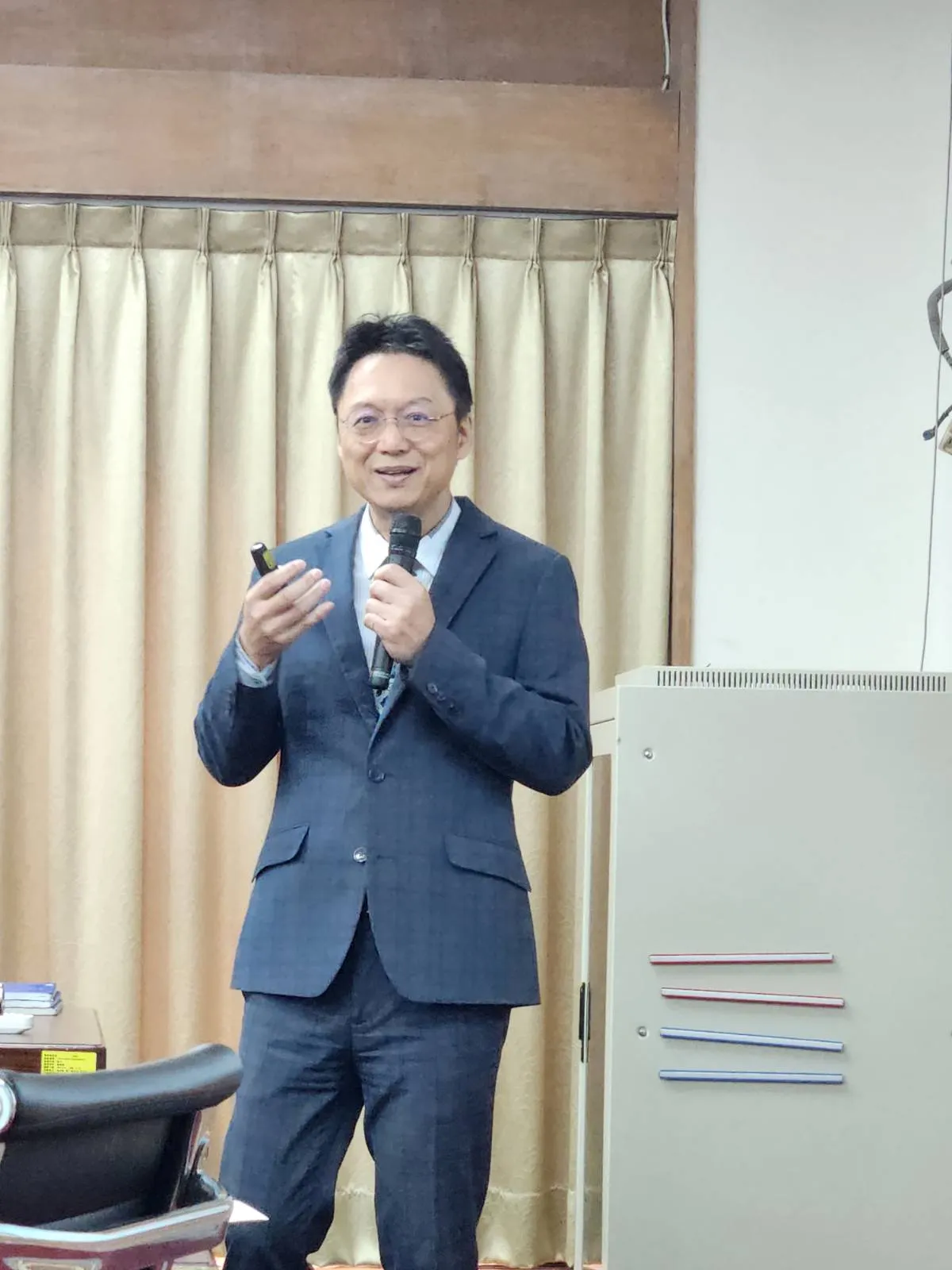
The opening presentation, by Prof. Cho Chung-hung (卓忠宏) of Tamkang University, looked at how the EU’s trade relationship with China is turning from economic interdependence into open geopolitical friction. His talk was titled 歐盟與中國經貿與地緣政治摩擦分析 (EU–China Trade and Geopolitical Friction: An Analysis).
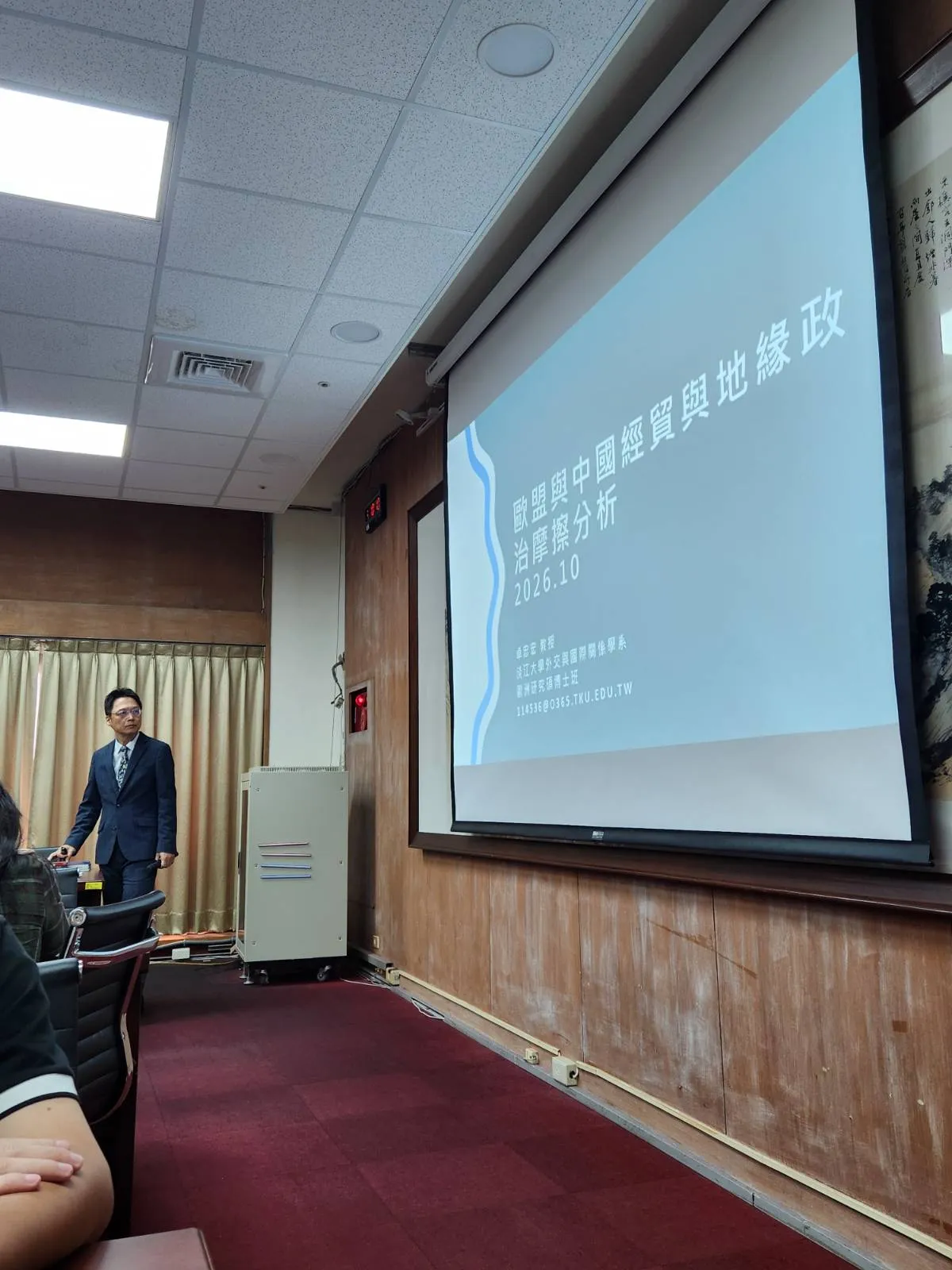
A shift in slogan. In 2022 the EU’s trade philosophy was “open strategic autonomy”: as open as possible, as autonomous as necessary. His slides argued that by 2026 it had hardened into “as open as possible, as closed as necessary”, a move from conditional free trade towards defensive, more protectionist measures.
The toolbox. The existing Anti-Coercion Instrument needs a qualified majority, which he argued makes it slow and weak as a deterrent. In October 2026, France and Germany proposed a tougher “kill switch”: once the Commission finds that a third country is coercing the EU, sanctions would take effect automatically within 24 hours unless a qualified majority votes against them.
His own view. This was the part I found most interesting. He argued that the kill switch’s reverse voting creates legal and sovereignty problems. It could stretch the Commission’s supranational power beyond what the treaties allow for common commercial policy, and it could shift the balance from negotiation between large and small states towards large-state dominance.
Prof. David Wu: Hungary after Orbán
The last speaker of the morning, Prof. David Wu (吳巨盟) of Shih Hsin University, took the same question from the side of a single member state. His talk was titled Hungary’s Political Shift after 2026 and the Transformation of Its China Policy: From “Opening to the East” (Keleti Nyitás) to “Normative Reshaping”. His core claim, as I understood it, is that Hungary’s new government is not abandoning China. It is making Chinese investment follow European rules, which raises its cost. Everything below comes from his slides and his paper.
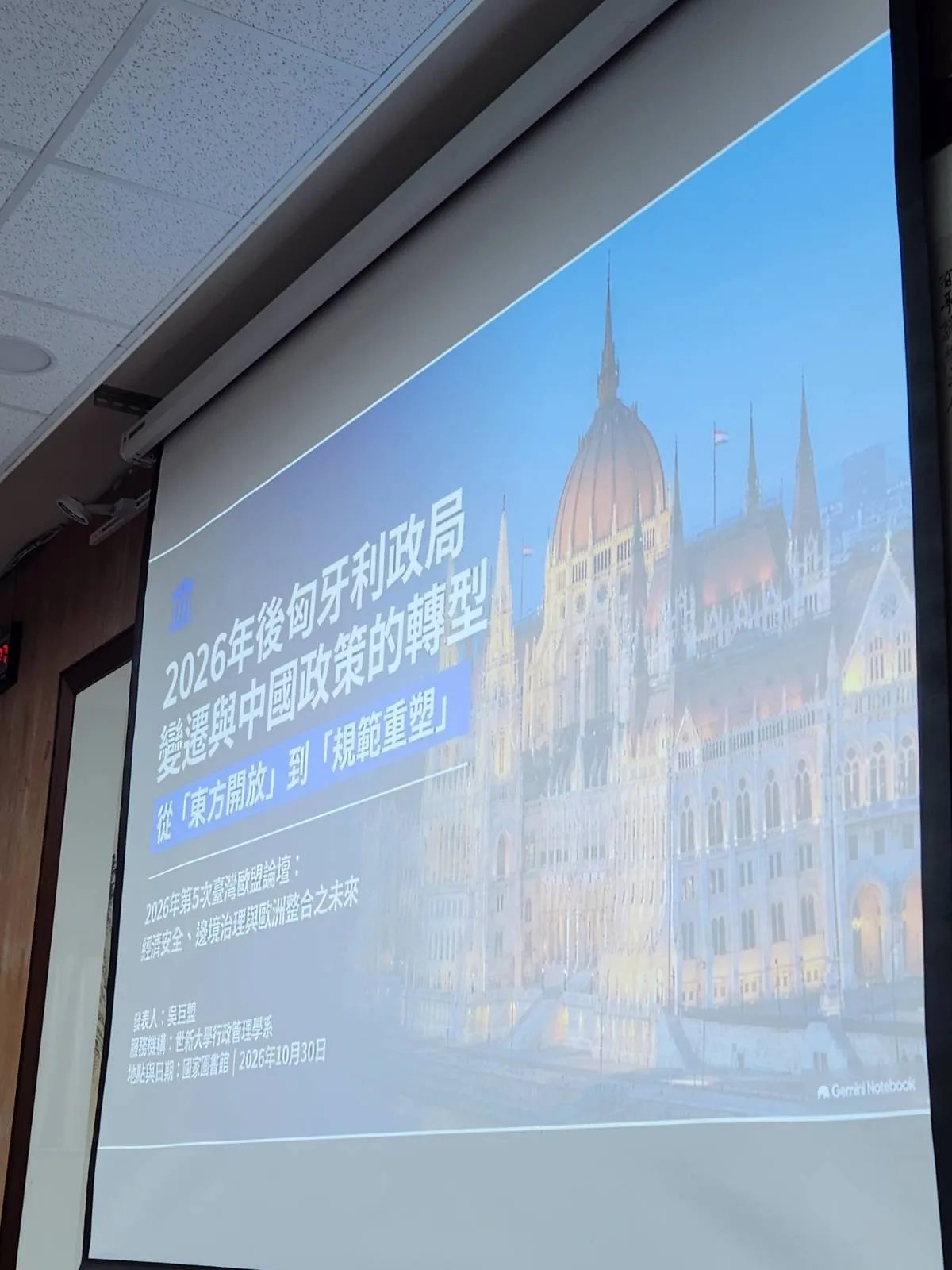

Two tracks under Orbán (2010–2026). Domestically, he described “legislative capture” of the courts, audit bodies and public media. Externally, he called it “geoeconomic arbitrage”: using EU membership and the Council veto to attract non-Western capital. According to his paper, the “Opening to the East” policy, introduced in 2011, made Hungary China’s gateway into the EU market and a friendly voice inside the Council. By his slide, about half of China’s green-tech and electric-vehicle investment in the EU ended up there.
Why it collapsed. He pointed to three structural crises: roughly €17–20 billion of EU funds frozen over rule-of-law concerns, stagflation (2025 growth of only 0.3%, according to his slide), and political scandals that split the elite. Péter Magyar broke with the Orbán system and mobilized young voters and a disappointed middle class. At the April 12, 2026 election, turnout was 78.99%, the highest since 1990, and his Tisza party won 141 seats, enough to change the constitution.
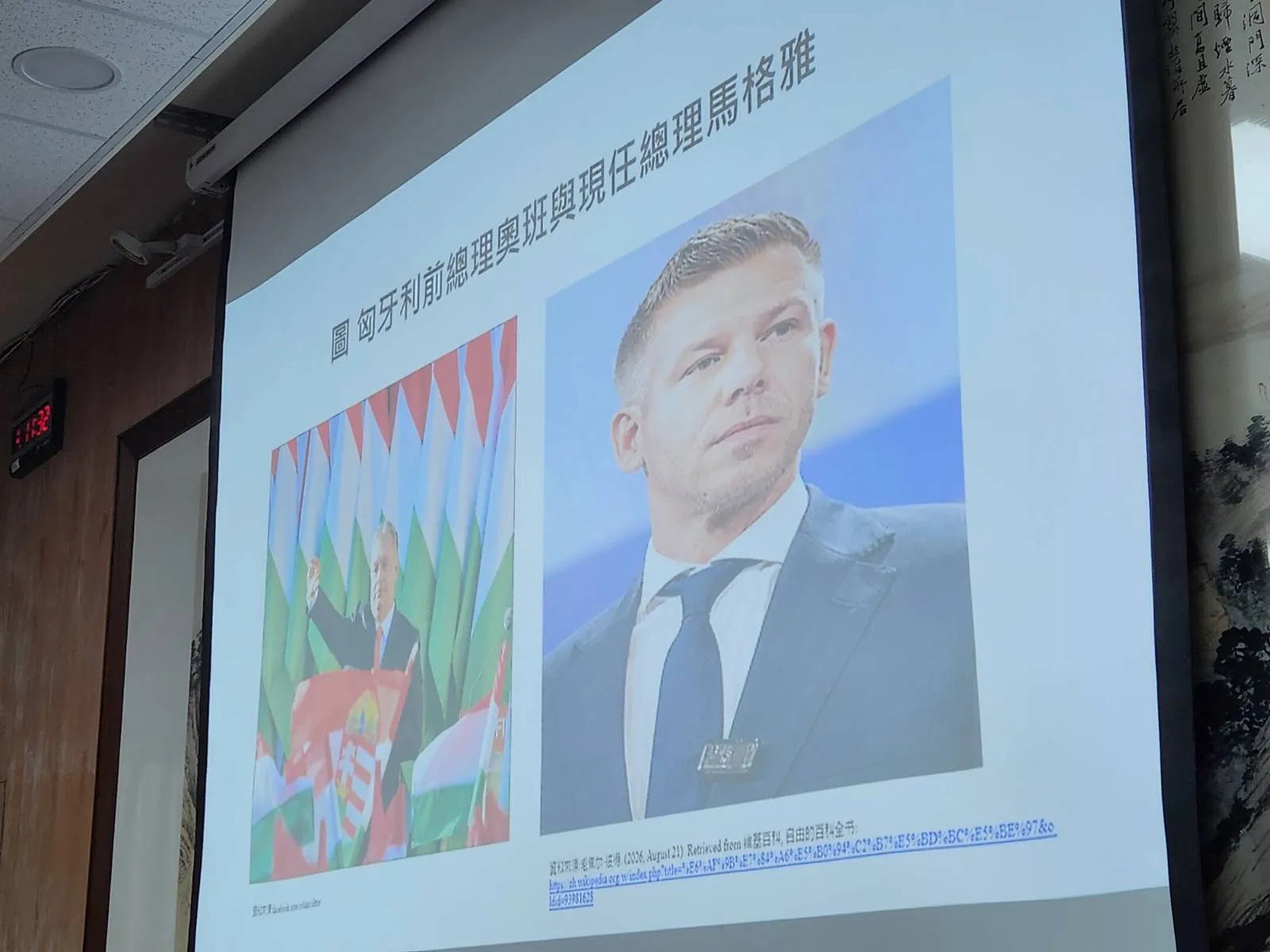
Rebuilding the state. Hungary joined the European Public Prosecutor’s Office, amended the constitution to cap a prime minister’s time in office at eight years, and began removing the old regime’s appointees from the courts, audit bodies and regulators. He also cited former foreign minister Péter Szijjártó’s move to BYD in July 2026 as the kind of politics–business link the new government wants to end.
The new China policy. His slide split it into two halves: pragmatic economics with no radical decoupling, and an end to political privilege and regulatory arbitrage. Hungary stops acting as “China’s agent in Europe”, gives up the diplomatic veto, and brings Chinese capital under EU single-market, competition and environmental rules. He tested this on three cases: the Budapest–Belgrade railway, whose Chinese signalling system did not meet the EU’s European Train Control System (ETCS) Level 2 standard; CATL, whose expansion was refused support in May 2026; and BYD’s Szeged plant, which is now under environmental investigation and subsidy review. His summary was that Chinese firms in Hungary should succeed on their market competitiveness rather than on public subsidies.
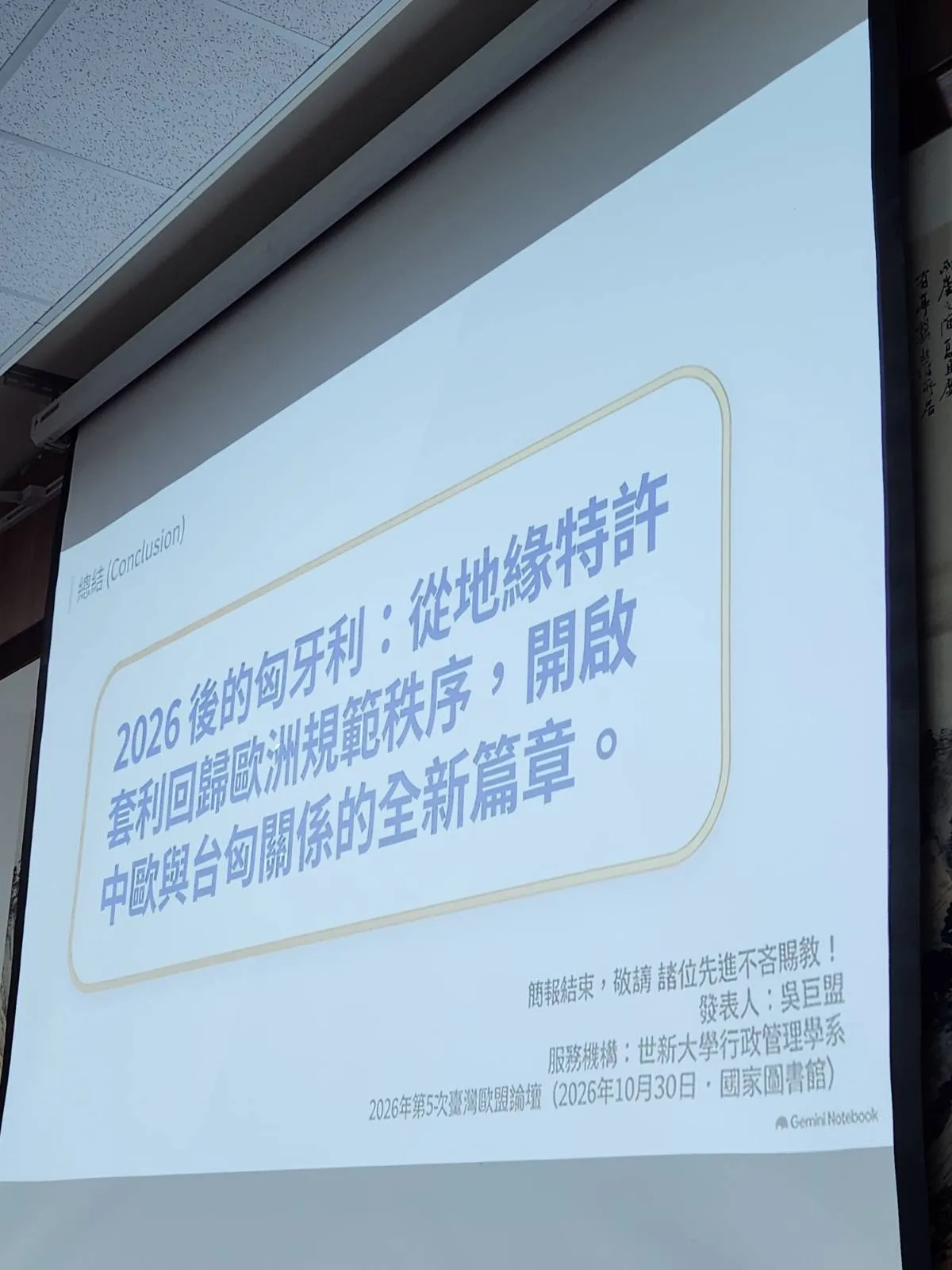
Taiwan. This was the part that connected most directly to where we were sitting. His slide presented a shift from “strategic silence” to “functional cooperation”. In his reading, Hungary’s stance is moving from Beijing’s One-China Principle toward the EU’s One-China Policy, with growing cooperation in semiconductors, culture and history, tied to the 70th anniversary of the 1956 revolution. His final slide summarized the whole shift as Hungary moving from geopolitical profit-seeking back to a European normative order, opening a new chapter for China–Europe and Taiwan–Hungary relations.
Afternoon: Academia Sinica
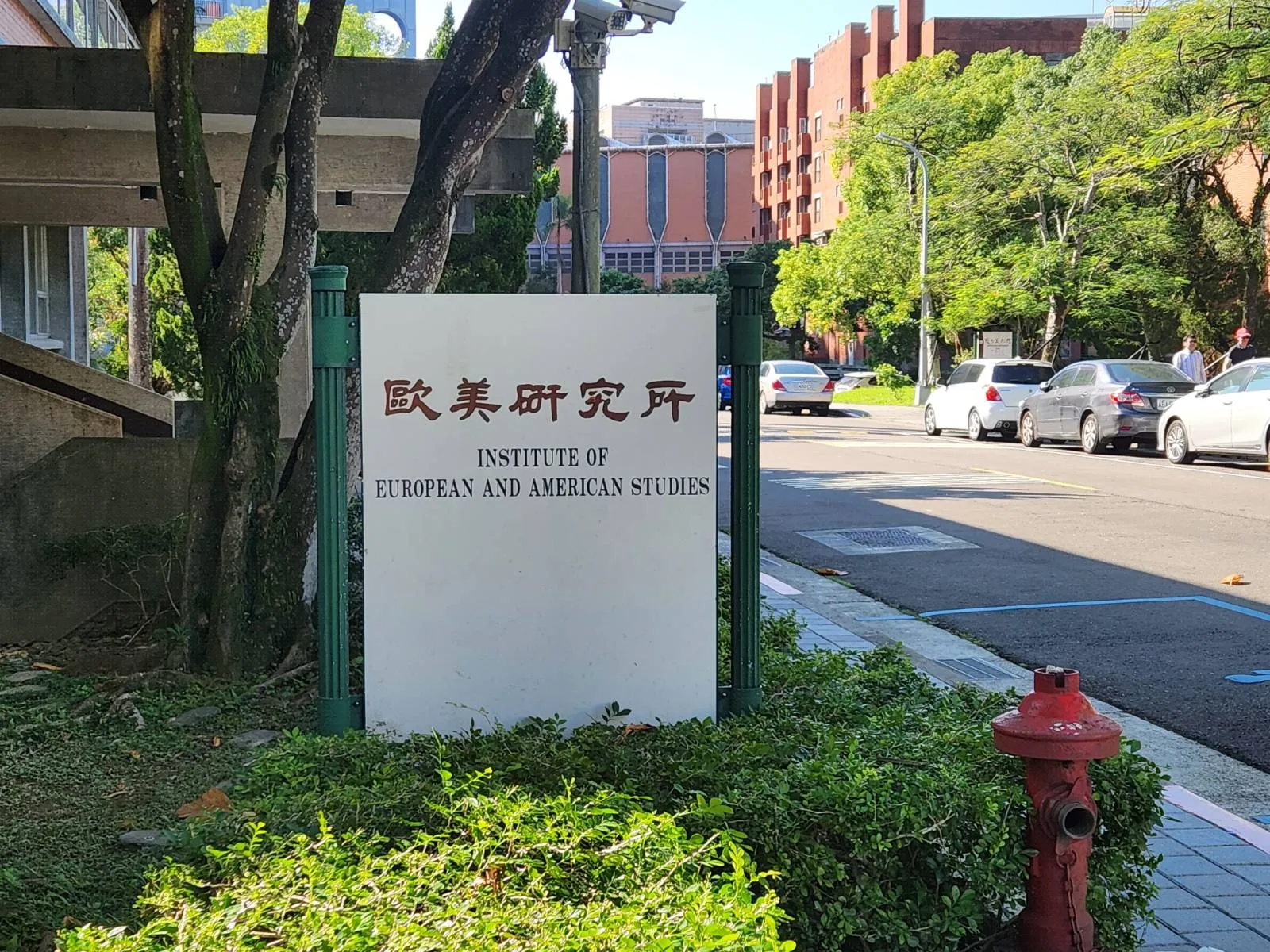
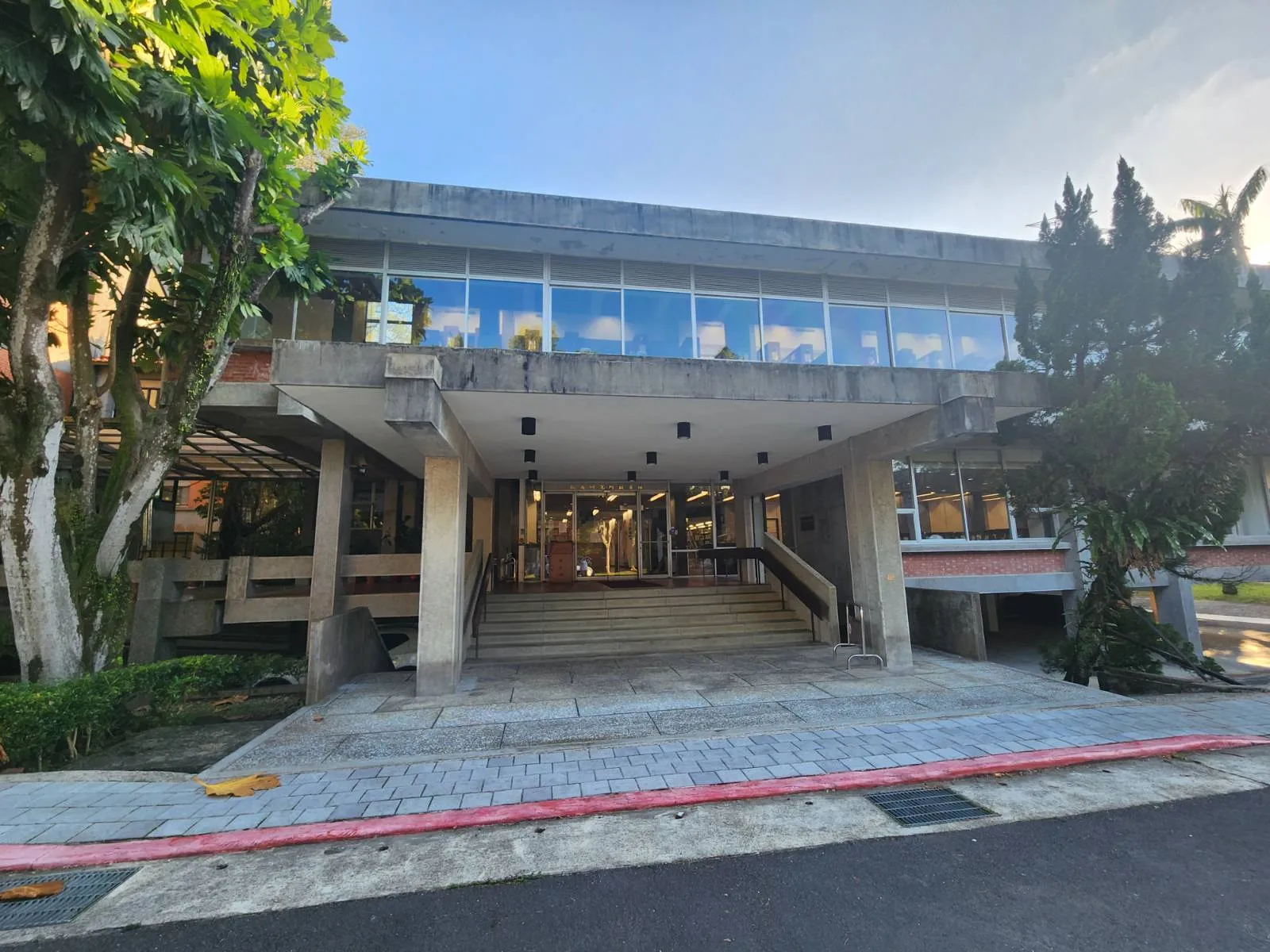
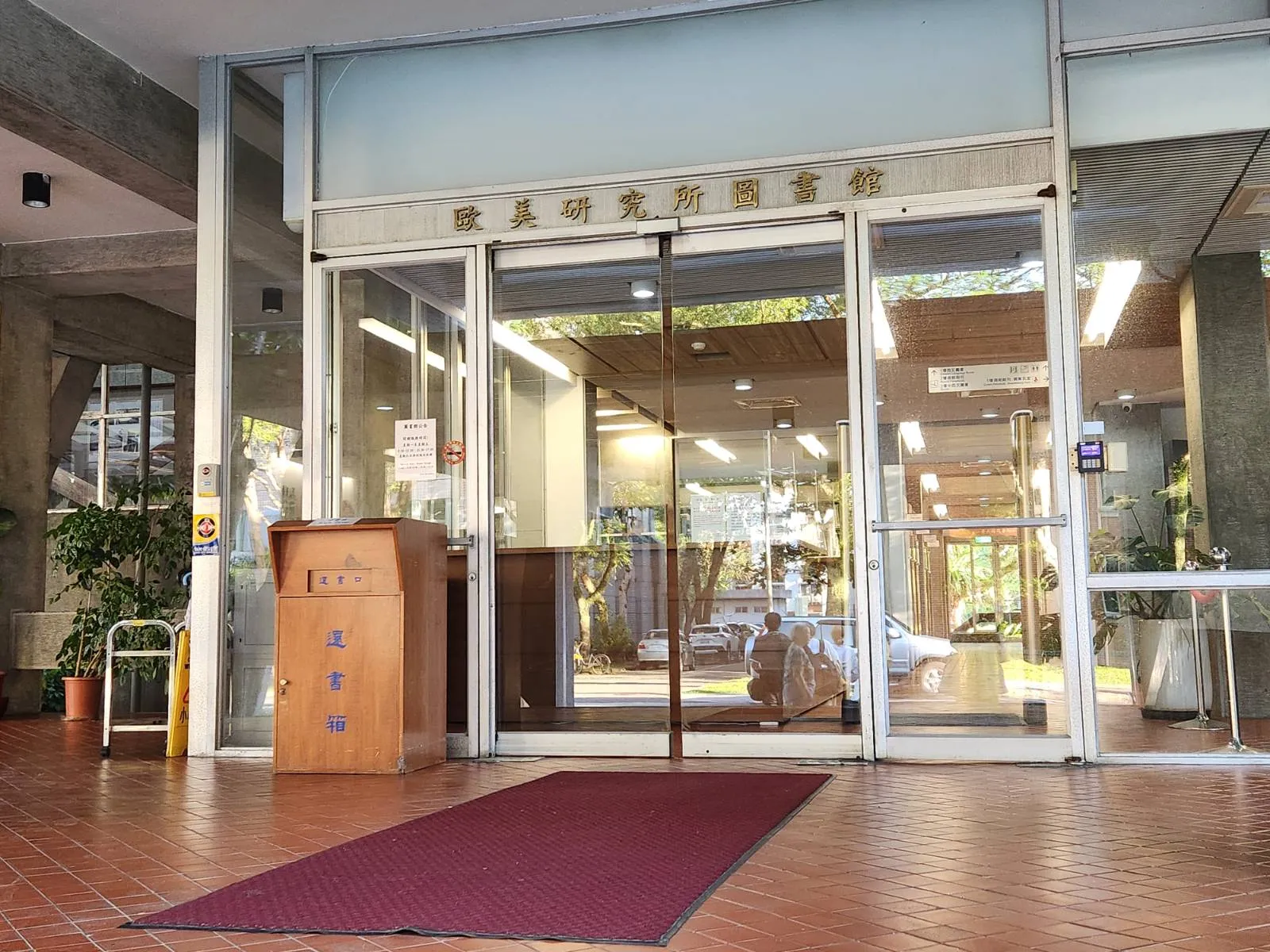
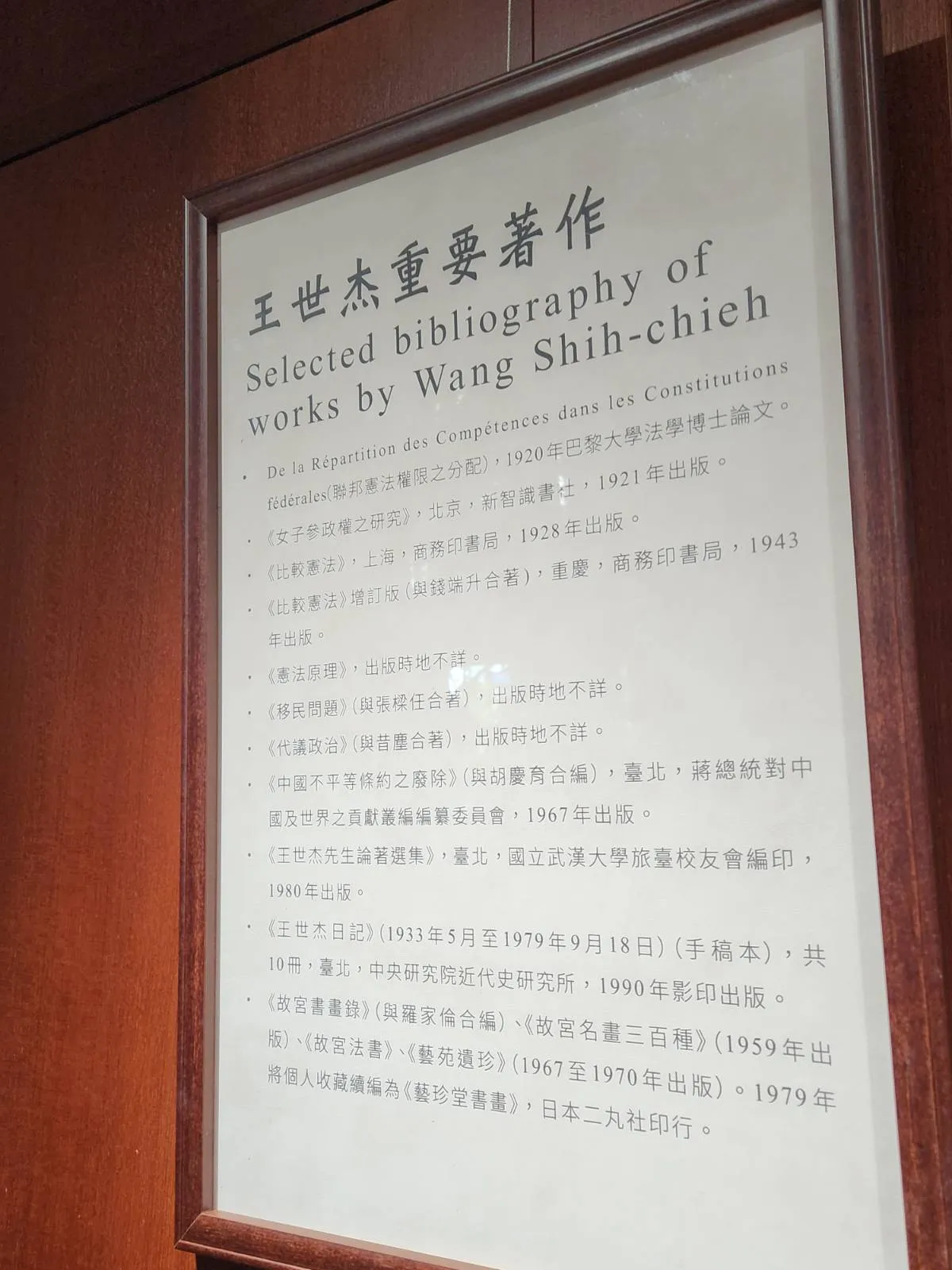
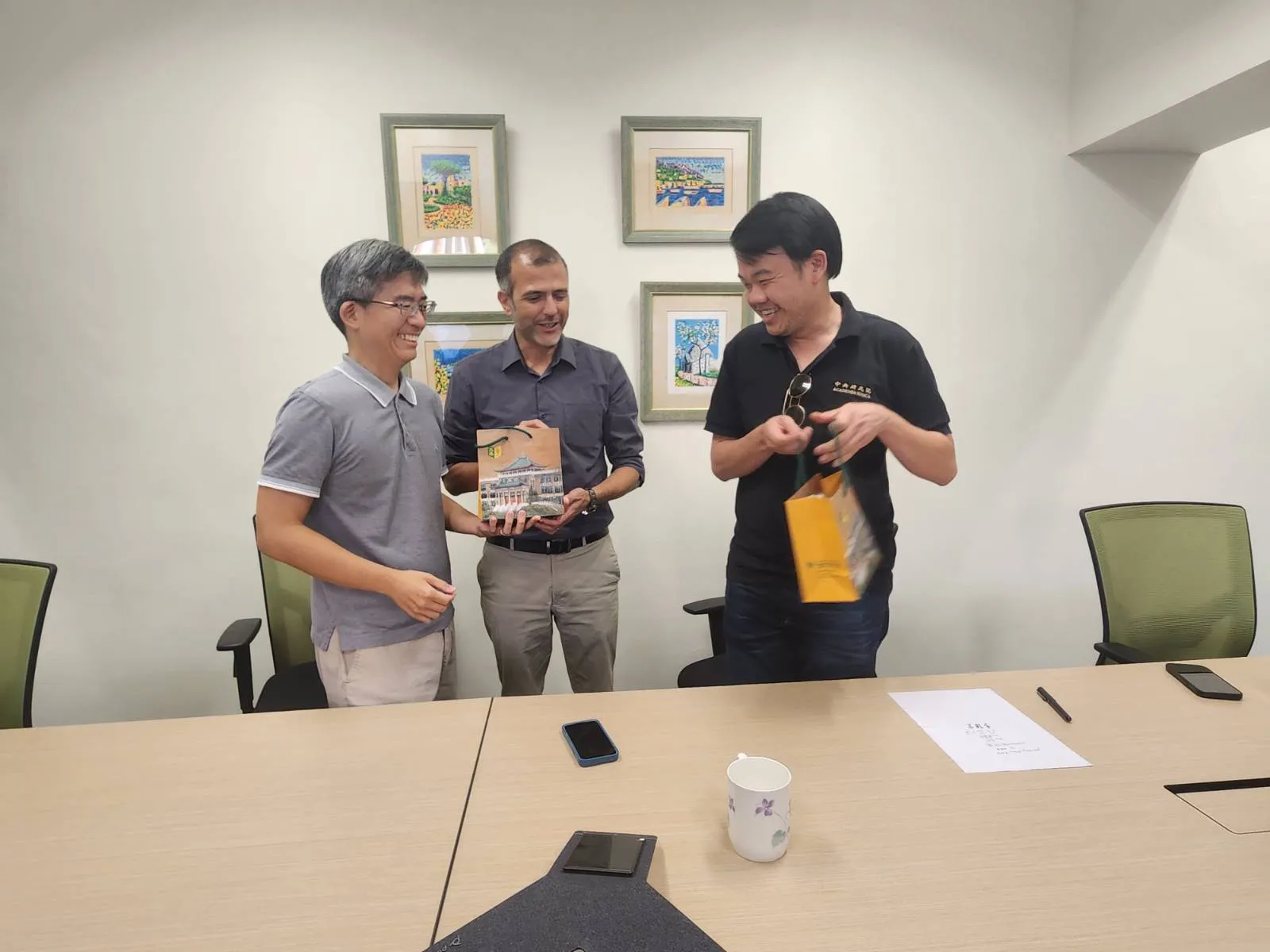
After lunch we visited the Institute of European and American Studies (IEAS) at Academia Sinica (IEAS website: https://www.ea.sinica.edu.tw/). Prof. Shaw Yung-Djong and Prof. James Lee welcomed us and talked with us about research on the EU and Taiwan, and about the pressing issues facing Europe today.





Prof. Shaw: federation, translation and Voltaire
Prof. Shaw (邵允鍾) is an Assistant Research Fellow (Assistant Professor) at IEAS. He trained in law, with a bachelor’s and master’s at National Taiwan University and then a doctorate in law at Humboldt University of Berlin. His areas of expertise are EU law, EU federalism, the EU’s political nature and the safeguard mechanisms of the EU’s constitutional values, as well as transitional justice.
The evening before the trip, Prof. Rollet mentioned that we might meet him. Late that night, I skimmed one of his recent papers, written in Mandarin: 〈歐盟的政治形式與歐盟條約的「國際社會契約」面向:重訪普芬道夫、孟德斯鳩與盧梭的聯邦政治體理論〉 (“The Political Form of the European Union and the Inter-State Social-Contract Aspect of the EU Treaties: Revisiting the Federation Theories of Pufendorf, Montesquieu and Rousseau”), published in 2024 in《人文及社會科學集刊》(Journal of Social Sciences and Philosophy), Volume 36, Issue 4, pp. 857–902.
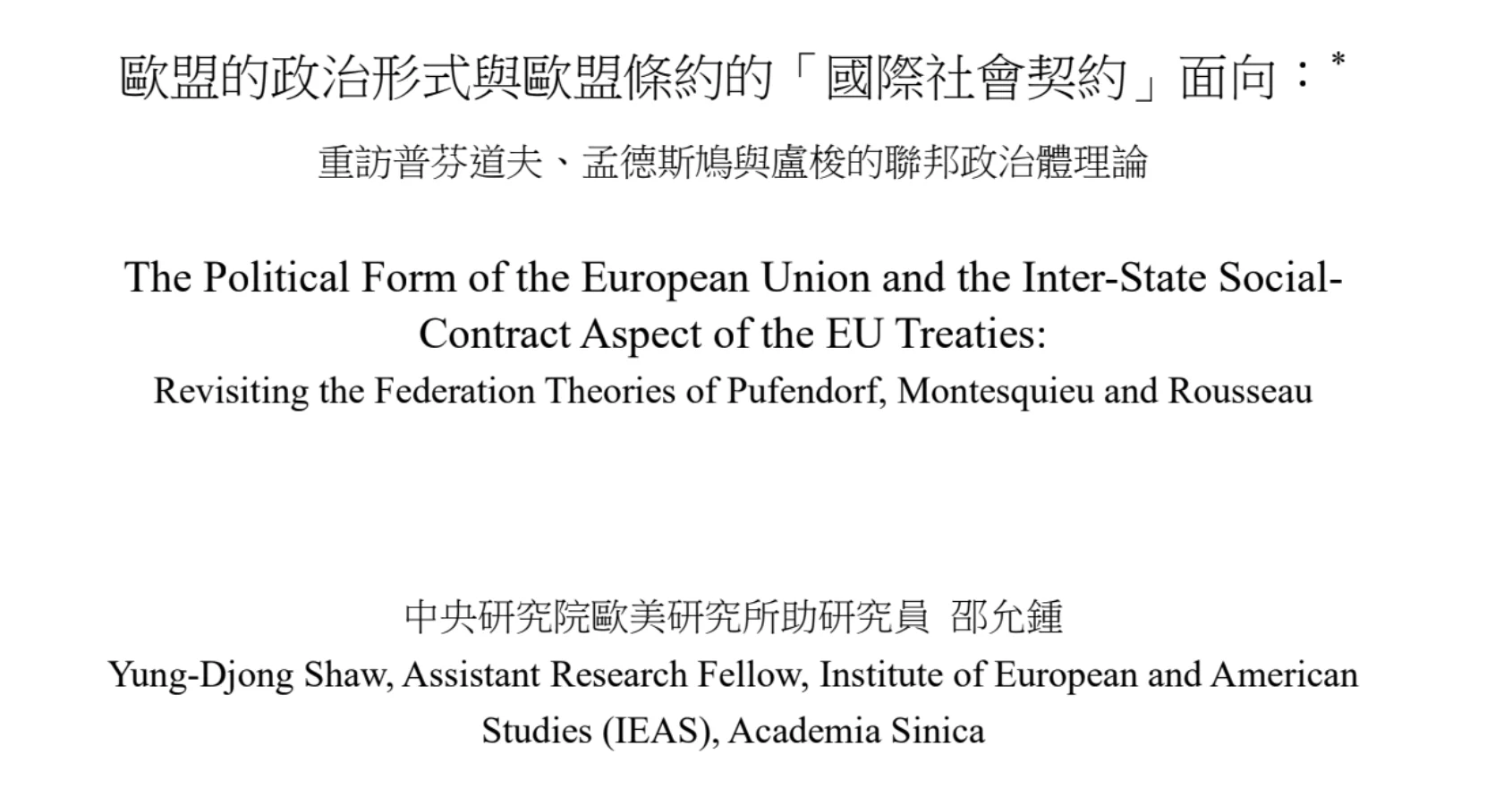
According to the abstract, the paper draws on Pufendorf, Montesquieu and Rousseau to argue that the EU Treaties are both an inter-state social contract and a federal constitution. Keywords: international social contract, inter-state social contract, federation, Global Constitutionalism, Constitutional Pluralism and demoicracy.
I prepared questions on the notion of a constitution (the Treaty establishing a Constitution for Europe and the Treaty of Lisbon), on translating “federation” and “confederation”, and on Montesquieu’s “society of societies”, as well as Taiwan’s ongoing constitutional crisis, which interested me as part of broader Taiwanese politics and law.
One detail in the paper caught my attention: footnote 51, on page 21, about Switzerland. Since the days of the old Swiss Confederation, it notes, Switzerland’s official German name has contained the word Eidgenossenschaft (誓約同盟, roughly “oath-bound alliance”, “oath commonwealth” or “oath alliance”), which preserves a trace of the concept of Eid, the oath. For how theological accounts of the sacred covenant and political theories of federation shaped each other in Swiss political integration, the footnote points to Baker (1993: 21ff).

This detail caught my attention partly because I’m currently taking Prof. Philipp H. Fluri’s course, and he is Swiss. He sometimes slips into German when speaking to me, not by mistake but because he is expressing something straight from his heart, such as his gratitude and appreciation for my intellectual engagement with him, which has given me extra motivation to learn the language. I have visited Geneva and Zürich before, and the country’s name changes with the language: the Swiss Confederation in English, Schweizerische Eidgenossenschaft in German and Confédération suisse in French. With a Swiss professor in the classroom, I have become more intellectually curious about Switzerland in general, and Prof. Shaw’s footnote 51 on the word Eidgenossenschaft and Switzerland’s official German name has made me even more interested in Switzerland, in German and perhaps in Swiss German too.
Another detail that greatly caught my attention is footnote 21, on page 7, because it deals with a Mandarin translation problem that bothers me a lot. I was glad that Prof. Shaw chose to discuss it explicitly, even if only in a footnote. He lists several Chinese options for federation: 聯邦, 邦聯, 聯盟 and 同盟. In his view, the 盟 in 聯盟 and 同盟 highlights the foedus (covenant or treaty) on which a federation is founded. That stresses its international-law side and neglects the federation’s own independent political existence. 邦聯 may be an even worse choice, since it calls up the picture of a loose international organization and cannot show that a federation is an independent political body. He notes that the French public lawyer Olivier Beaud (2009: 20) had the same worry. Beaud chose fédération over confédération because the latter makes readers think of a pale, weak organization of international law, when a federation is in fact une entité politico-juridique. Translating federation as 聯邦 has its own risk, because it can be confused with 聯邦國 (a federal state). So Prof. Shaw accepts the inconvenience of coining a new Chinese term and translates federation as 聯邦政治體 (roughly “federal polity”). He adds that Liao Li-wen (2007: 45) used the same term for federal entity in Belgium, but that 聯邦單元 (roughly “federal unit”) would be more precise there.
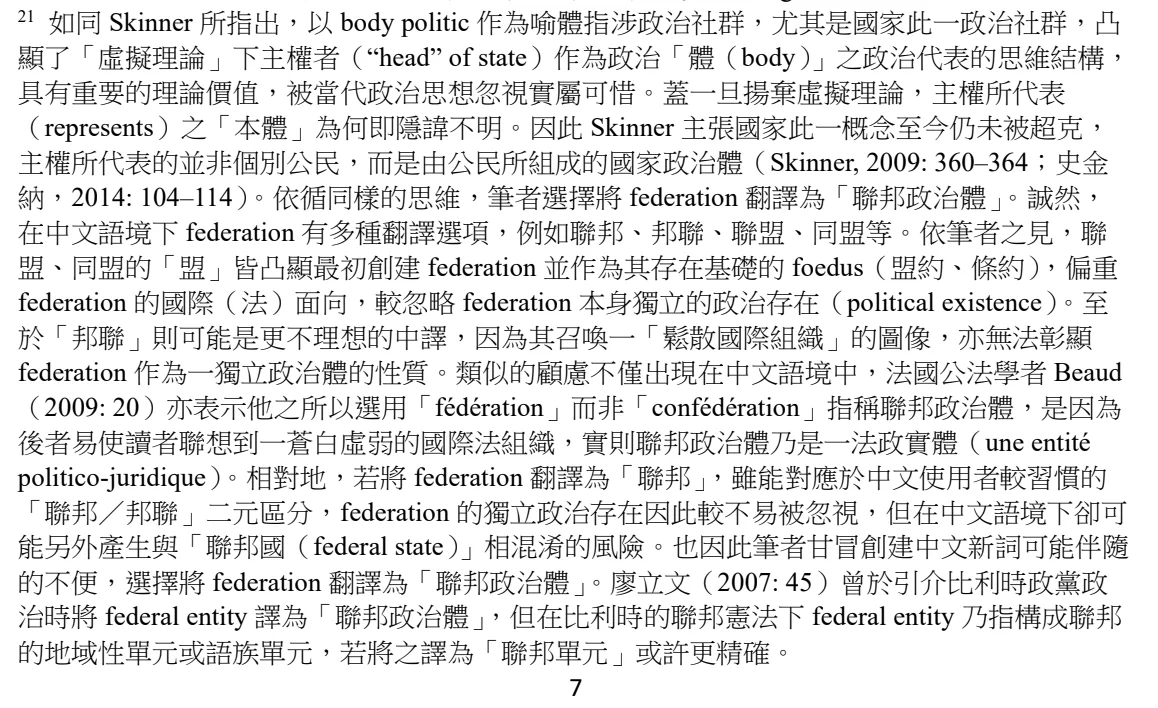
I sometimes get a little obsessed with translation and terminology. The paper notes that later writers distinguish fédération from confédération (聯邦 versus 邦聯), so I asked about Montesquieu’s “society of societies” (une société de sociétés) and about a footnote on exactly this point. Montesquieu used the two terms as synonyms, without the later split. Because 邦聯 suggests a loose union, which clashes with his image of states giving themselves up entirely, Prof. Shaw translates every related term as 聯邦.
In response, he offered a quote about the Holy Roman Empire: 「神聖羅馬帝國,既不神聖,也不羅馬,更非帝國」. It is Voltaire’s line from the Essai sur l’histoire générale et sur les mœurs et l’esprit des nations (1756), Chapter 70:
Ce corps qui s’appelait et qui s’appelle encore le saint empire romain n’était en aucune manière ni saint, ni romain, ni empire.
In English: this body which called itself, and still calls itself, the Holy Roman Empire was in no way holy, nor Roman, nor an empire. As I understand it, Voltaire was not dismissing the empire as such. His point was that after the Great Interregnum its politics had become so loose and inefficient that the name no longer fit.
A constitutional crisis closer to home
I also asked briefly about the constitutional crisis happening right now in Taiwan, the issue I most wanted to understand. In August 2024, President Lai Ching-te (賴清德) nominated seven Constitutional Court justices, and the Legislative Yuan rejected all seven. He nominated seven again in 2025, and they were rejected again. Under legislation passed by the KMT-controlled legislature, the court needs at least ten justices to deliberate, so it cannot function.
A more recent Hoover Institution piece (October 1, 2026) summarizes Kharis Templeman’s article “Taiwan’s Deadlocked Democracy” (Journal of Democracy, Volume 37, Number 4, October 2026, pp. 115–129) (DOI: https://doi.org/10.1353/jod.2026.a1001901). Templeman, a Hoover research fellow, argues that the deadlock since May 2024, which has also left regulatory bodies vacant and the budget half a year late, is not mainly about polarization or PRC influence. Taiwan’s institutions are simply not designed for divided government, and unified government hid that flaw for years.
Meeting Prof. Lee Again
Prof. Lee is a scholar of strategic studies, working on Ancient Greece and the Cold War, U.S. foreign policy, and the legal status of Taiwan in transatlantic relations. He also turns to literature and film. In September he gave a talk at the Institute titled “Homer’s Heroes in Nolan’s Epic”, on Christopher Nolan’s film adaptation of the Odyssey (event page: https://www.ea.sinica.edu.tw/Content_List_Page.aspx?pid=0&uid=237&cid=65590). According to the abstract, he argues that the film is less a representation of Homeric myth than of American ambivalence toward the heritage of ancient Greece, seen in its casting, its dialogue and its portrayal of Odysseus’ guilt over the Greek victory at Troy. Nolan’s Odysseus is a morally tainted protagonist who finds redemption only within limits, and Prof. Lee traces this moral transgression visually through food and feeding, and through the contrast between land as a site of transgression and water as a site of punishment and atonement.
I recognized him the moment I saw him, because I had seen him two weeks earlier. On Friday, October 16, I attended the afternoon session of the international workshop “Taiwan and the Sociology of War” at Academia Sinica’s Institute of Sociology (I wrote about it here). Prof. Lee was one of the discussants near the end of that day, and he made a brief comment on a passage from Benedict Anderson’s Imagined Communities. It is the one moment from that final discussion that I remember best, partly because I recognized the book. I had skimmed several of Anderson’s books in a bookstore before, so the name stuck with me when everything else from that session blurred together.
As I recall it, the moderator then added that the passage seemed to have been used somewhat out of context, and that the paper’s author needed to think harder about why the quotation belonged in the paper at all and what work it was doing for the argument. I’m going from memory, so I may have some details wrong. What I’m confident about is that Anderson came up and that the discussion turned on how a quotation is used. For a master’s student writing papers of my own, that was a useful reminder that every quotation has to earn its place.
Meeting him again in a smaller setting, what I didn’t expect was how familiar he felt. Before this master’s program, I worked in computer science, software engineering and cryptographic research, around American and Canadian colleagues. When Prof. Lee talked through his research ideas, I recognized his style at once, with the same easy, direct way of explaining his thinking. It felt like listening to one of my former work colleagues, now friends, even though the subject matter could hardly be more different.
Since the topic of his recent talk on Nolan’s Odyssey came up in conversation, I mentioned that I had watched the film three times in movie theaters. What bothered me was that the “Nobody” episode from the poem, where Odysseus tells the Cyclops that his name is “Nobody”, appears in the film but is not depicted as faithfully, line by line, as it is in Homer’s epic poem. I know Nolan never meant to follow the epic poem exactly, but I still wished the scene had been closer to the original. I have also read parts of Homer’s Odyssey in Robert Fitzgerald’s translation (the Picador edition, with a new introduction by Laura M. Slatkin), and I can still recite its opening lines: “Sing in me, Muse, and through me tell the story / of that man skilled in all ways of contending, / the wanderer, harried for years on end, / after he plundered the stronghold / on the proud height of Troy.” So I greatly admire Prof. Lee’s ability to research and analyze Homer’s work in Ancient Greek, the language of the epic poem, which is not Modern Greek.
One Last Question
Before leaving, I asked Prof. Shaw why he chose Germany for his PhD. He had always assumed he would go to the US, since his advisors were educated there, but thought it might be too costly. Scholarships then led him to Germany. He learned German on site through immersion, with daily life and his courses all in German.
Reflecting Through Writing
While writing and editing this post about the Friday day trip to Taipei, I dug into the research papers, news articles, websites and books behind what I had heard. Looking back on the trip, and doing so through the act of writing itself, has been good for me, because it has built up my basic knowledge across several topics. I have two courses with the European Studies students and two more with the students in the Department of International Affairs, which is essentially international relations, so it seems like a good idea to build this context and foundation before diving into specific topics and theories.