Notes from the Taiwan and the Sociology of War Workshop
I came across this workshop by chance while browsing some of the Academia Sinica websites the other day. At the time, I was very interested in Poland’s economy and history in general, and I had been chatting with a few Polish people living in Taiwan. So even though I knew very little about war studies or sociology, I still wanted to go and meet this Polish researcher, Artur Kościański, Associate Research Fellow at the Institute of Philosophy and Sociology of the Polish Academy of Sciences. I expected he might talk about something related to Poland, such as its history or grassroots movements, so it didn’t really bother me that the workshop’s main theme was war.
I didn’t arrive until the Friday afternoon session (October 16) of the international workshop “Taiwan and the Sociology of War: From Ideology to Everyday Life” at the Institute of Sociology, Academia Sinica, in Nangang, Taipei. That meant I had missed the morning speakers and the whole previous day.
This post covers two contributions from the afternoon. The first is Artur Kościański’s talk on war preparedness culture and social resilience in Poland and Taiwan. The second is Po-Yi Hung’s response to Hsiu-hua Shen’s paper on the Kinmen–Xiamen maritime border.
Poland: resilience built from below
Artur Kościański, Associate Research Fellow at the Institute of Philosophy and Sociology of the Polish Academy of Sciences (IFiS PAN), presented “War Preparedness Culture and Social Resilience in Poland and Taiwan: A Comparative Perspective.” His central claim was that Poland’s resilience is not only a state project. Much of it is being built by civil society, and his research sets out to map that work. The state does play a part, but in his account, the more interesting story is the range of civic organizations that prepare people for crises in very different ways. He walked through three of them.
Combat Alert and practical skills
Combat Alert sits at the most hands-on end of the spectrum. It focuses on practical skills, meaning what ordinary people need to know and be able to do when a crisis arrives.
ZHR and education, not militarization
ZHR, a Polish scouting association, works at the opposite end of the spectrum. Kościański stressed that ZHR is non-military. Its work is mostly educational and aimed at young people. It teaches children to take responsibility for public goods and prepares them to contribute to the country’s future. The scout uniform, he explained, is worn as a sign of unity, not as a military signal.
Sokół, somewhere in between
Sokół began as a gymnastics and physical education movement rooted in patriotic values. Over time, it became more of a political organization. Kościański placed it between the other two. It is more civic and value-driven than Combat Alert’s skills training, but closer to collective mobilization than ZHR’s youth education.
The value of this map is that it breaks “preparedness” down into distinct cultures. Skills, values, and civic responsibility are different routes to resilience, and each implies a different relationship between citizens and the state. This is the comparison Kościański brought to Taiwan, where similar debates about civil defense and whole-of-society resilience are underway.
Talking with Kościański afterwards
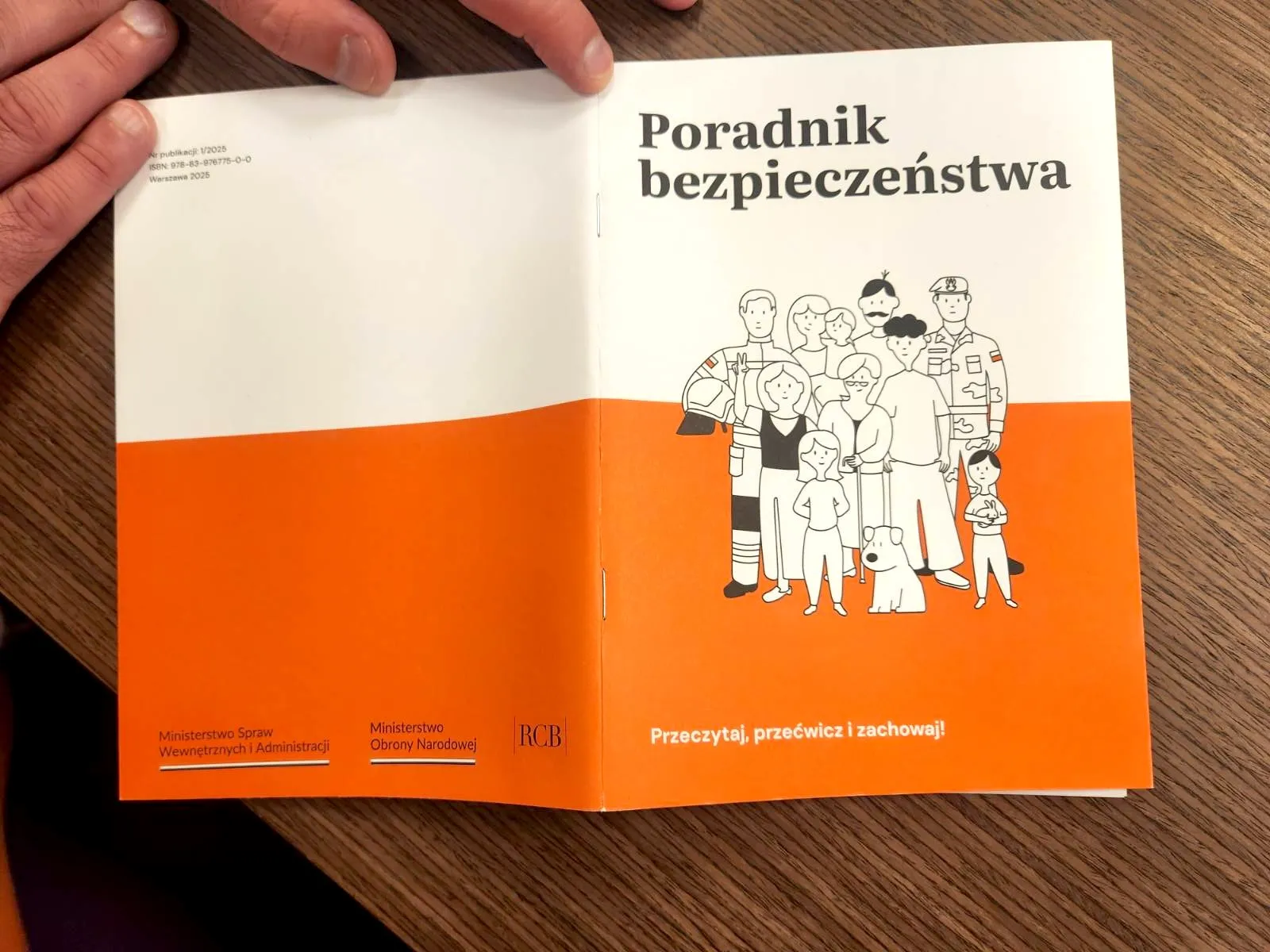
After Artur Kościański’s presentation, I took a look at the booklet in the photo above, the Poradnik bezpieczeństwa (Safety Guide). It is an official Polish government publication from 2025 that helps people prepare for emergencies and crises.
He also told me about mObywatel (mCitizen), the Polish e-government mobile app, which Polish people can use for their digital identity documents, such as their driver’s license. He briefly mentioned Liga Obrony Kraju (LOK, the League of National Defence), the fact that people in Poland can buy guns for self-defence and to protect their families, and volunteer firefighter groups in Poland (unfortunately, I didn’t catch their Polish name). The insights and information he shared with me were genuinely valuable.
He felt that discussions in Taiwan focus mostly on the technical side, and that Taiwan’s civil society resilience work is largely technical as well. In Poland, by contrast, people are more aware of the historical roots of this work. Polish people’s moral values and sense of patriotism, along with a general distrust of the Polish government, are what keep civil society resilience efforts going. I enjoyed meeting him in person, and it was fun to learn a bit more about Poland in general.
Kinmen: reading the border in volume
Hsiu-hua Shen, Associate Professor at the Institute of Sociology, National Tsing Hua University, presented “Cross-Border Infrastructure and Territorial Reconfiguration: Political Warfare at the Kinmen Border.” Po-Yi Hung, Professor of Geography at National Taiwan University, served as discussant. In about ten minutes, he offered a compact geographer’s reading of the Kinmen–Xiamen border, built around three points. Below are the notes I took while he spoke; I hope I’ve captured his points accurately and that they’re helpful.
Point 1: Water as a thick border (or “a body of water with thickness”)
The border is an orchestration of protective barriers, ferries, and patrols.
Point 2: Land–ocean–sky inter-bordering
The border is made of four layers that shape each other: land, sea surface, seabed, and sky. Sovereignty therefore looks different depending on which layer you read.
Point 3: Volumetric reordering of territory
Land making, overlapping airspace, and sea fog show territory being reordered in three dimensions, which reopens the question of sovereignty.
Framework: Stuart Elden’s volume geography and the volumetric turn in political geography treat territory as a volume with height and depth, not as a flat area.
Land making, overlapping airspace, contested environment, materiality of the fog: Kinmen’s spring sea fog is a material force in the border. It grounds flights, suspends ferries, and blinds visual surveillance, so whether and how the border operates depends on the weather. The elements reorder the border, not only states.
Point 3, continued: grey zones, infrastructure, and media
The border is also reordered through grey zones, where neither war nor peace applies and the sea stops working as a clean dividing line.
Geopolitical grey zones, people of the sea, bridges as grey-zone infrastructure, waters that no longer serve as borders.
AI, tech, and mass media as borders: AI-generated videos of a finished Kinmen bridge create the illusion of a connection that does not exist. Media becomes a bordering layer of its own, reshaping how people imagine distance and belonging. The border is contested in perception as well as in water, seabed, and sky.
Follow-up discussion: ferries, boats, bridges, and irreversibility
Ferries and boats keep a maritime boundary reversible, whereas a bridge would make the change permanent and irreversible. This ties back to Point 3: a bridge is grey-zone infrastructure because it locks in a political outcome through its material form, before any agreement exists.
Reflections from the audience
I enjoyed attending this international workshop. I was glad to see the Taiwanese sociologist 蕭新煌 (Hsin-Huang Hsiao), Adjunct Research Fellow at the Institute of Sociology, Academia Sinica, in person while he moderated the first two and a half hours of the afternoon panel (from 13:00 to 15:30). I’m not sure why, but I found him the most interesting person in the room. Another researcher I thought was pretty cool was 謝斐宇 (Michelle Fei-yu Hsieh), Associate Research Fellow at the Institute of Sociology, Academia Sinica. Her research topics are less related to my own interests, but it was great to see her present her work on personal protective equipment (PPE), small and medium-sized enterprises (SMEs), and Taiwan’s economic resilience in the face of crises. It was reassuring to see that there are researchers in Taiwan who are still trying to make an impact through their academic work. Some of the discussants and paper presenters were hard for me to follow, perhaps because of speaking styles or accents I wasn’t used to, but overall the workshop was quite inspiring.
Simply participating was quite a relaxing experience. In my master’s courses, I am usually the one asking questions during seminars and discussions. It has been this way since college. I’m used to being the only person who bothers to think of a question and ask it directly to the professor, lecturer, or panelist on stage. I think that’s part of what led me to spend several years as a tech journalist, which gave me the chance to ask even more questions in one-on-one conversations. There are still so many topics left to explore and fields yet to be discovered.
At Academia Sinica, Taiwan’s leading research institution, I got to sit back and watch from the front row as real public intellectuals posed their questions. Many of the follow-up questions interested me. They didn’t feel like attempts to show off, but like questions that needed to be asked and deserved to be discussed in public. That might be the most valuable thing I took away from this workshop.
I came for a Polish researcher and left with a new way of thinking about Taiwan. Seeing how another society builds resilience from below made me wonder what Taiwan’s own version of that story might look like. I’m glad I made the trip and got to meet everyone in one place. It was a reminder that some of the most rewarding experiences come from simply following your curiosity and showing up.